News
Share


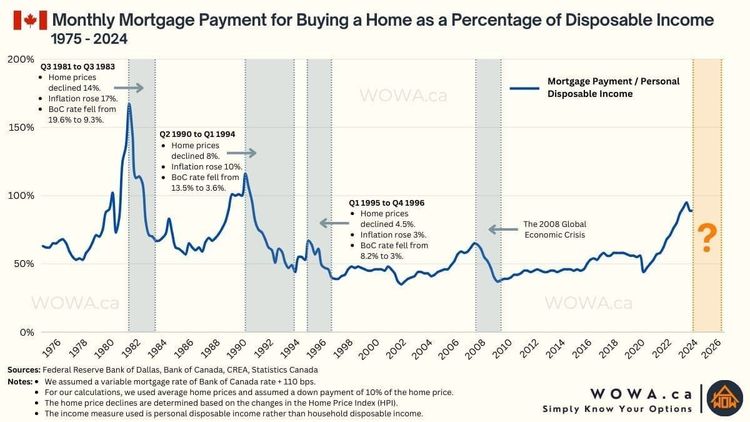
The bigger picture: The Canadian housing market is experiencing significant strain, with mortgage payments for recently purchased average properties consuming nearly all of the average individual's disposable income. This level of unaffordability has only been seen twice before: around 1981 and 1990. Historical data suggests that even when mortgage rates drop from their peaks, it doesn't always give the real estate market a boost. For example, in the early 1980s and early 1990s, even substantial rate cuts couldn't stop home prices from taking a nosedive. This trend is something prospective homebuyers should definitely keep in mind as they navigate the current market conditions.
Making the news: The Bank of Canada recently cut its benchmark rate for the second time in two months, leading to the lowest mortgage rates we've seen in the past 17 months. Despite the low rates, the Toronto and Vancouver housing markets remain relatively stagnant. On the flip side, more affordable markets like Montreal, Calgary, and Edmonton are thriving. In Toronto, one of Canada's least affordable markets, the sales-to-new-listing ratio is sitting at 35%, indicating a buyer's market with inventory levels at their highest since 2010. This situation is eerily similar to past periods of high unaffordability, like in 1981 and 1990, when significant rate cuts didn't lead to immediate improvements in the housing market.
Reading between the lines: Historical trends show that home prices tend to drop when affordability improves from peak unaffordability due to the lag effect of rate hikes and economic deterioration. In Canada, most mortgages are fixed rates, so the real impact of rate hikes is felt primarily during renewals. This often pressures some sellers to offload their properties. Additionally, rate cuts usually signal a slowing economy, higher unemployment rates, and possibly lower self-employed earnings—all factors that contribute to decreasing home prices. For example, during the global financial crisis of 2007-2008, home prices decreased by 9% even as the BoC rate fell significantly.
Looking ahead: The Canadian housing market is expected to perform differently across provinces. While Ontario has seen a decline in home prices recently, Quebec and Alberta are experiencing steady growth. Based on historical performance, it's likely that Ontario, especially the Greater Toronto Area (GTA), will see some price moderation. In contrast, Alberta and Quebec may remain relatively stable. Prospective homebuyers should be exceptionally prudent with their finances, considering both immediate costs and long-term commitments. Financial advisors recommend creating comprehensive budgets that include emergency savings and account for potential future rate hikes or economic downturns. Understanding historical rate cycles and market trends can provide valuable insights for making informed decisions about purchasing property.

Volunteers unite to protect a vital homeless support service in Kitchener.

The technology behind Canada’s Olympic House could influence future homes.

Discover whether Toronto is truly ready for high-density living, why buyer expectations are changing, and what experts say this means for future homebuyers.

Canada plans to use public land to accelerate affordable housing development.

How Bank of Canada rate cuts could impact housing affordability in Vancouver.

Tesla’s home technology allows families to generate income from solar energy.


